Micron's 2027 memory is 75% sold and the shortage keeps worsening
Key takeaways
- Micron says about 75% of its 2027 memory output is already spoken for and expects demand to exceed supply in both 2027 and 2028
- TrendForce expects conventional DRAM contract prices to rise 10 to 15% and NAND flash 15 to 20% in the fourth quarter of 2026
- Alphabet, Amazon, Microsoft and Meta planned more than $700bn of 2026 capital spending, and Microsoft says about $25bn of its plan simply covers higher component prices
- The biggest buyers report contracted backlogs in the hundreds of billions of dollars, though free cash flow has turned negative at Alphabet and Oracle
- If you are buying or renewing, waiting is unlikely to help: lock quotes, check how long they are valid and consider longer contract terms with a price hold
In August, a buyer placed an order for an Asus ROG Astral RTX 5090 graphics card through Nvidia's own marketplace, at $4,429. Asus told Nvidia it could no longer supply the card at that price, and the order was cancelled outright. The same card now lists at $4,982, according to The Next Web, nearly 2.5 times Nvidia's original Founders Edition price.
A cancelled graphics card order sounds like a gamer's problem. It is not. It is the same squeeze that is cancelling quotes for laptops, adding to the bill for cloud servers and pushing up the price of a Raspberry Pi.
The cause is simple to state and hard to fix: the AI build-out is buying the world's memory and chipmaking capacity years in advance, and the companies that make those parts say the market will be tighter next year, not looser.
Here is why the shortage is not getting better, why it is not a rerun of the dot-com bubble, what could still go wrong, and what to do if you are about to buy or renew.
The short version
- Micron says about 75% of its 2027 memory output is already spoken for, and that most of its current sales talks are about 2028.
- Samsung has signed supply deals of at least five years with the five largest data centre operators, covering 60% to 70% of its future capacity.
- TrendForce expects conventional DRAM contract prices to rise another 10% to 15% in the fourth quarter of 2026, and NAND flash 15% to 20%.
- Alphabet, Amazon, Microsoft and Meta planned more than $700 billion of capital spending for 2026, and Alphabet and Amazon have raised theirs since.
- Microsoft says about $25 billion of its 2026 spending buys no extra capacity. It just covers higher component prices.
Sold before it is made
Start with memory, because that is where the shortage bites hardest.
On 30 September, Micron reported fiscal fourth quarter revenue of $54.23 billion, against $41.46 billion the quarter before and $11.32 billion a year earlier. Full year revenue reached $133.19 billion, up from $37.38 billion. Gross margin in the quarter was 86.8%. It guided to about $61.5 billion for the first quarter of fiscal 2027.
The comments on the call matter more than the numbers. "We do not have line of sight to when supply and demand will return to balance," chief executive Sanjay Mehrotra said, as reported by The Next Web. He said demand will exceed supply in both 2027 and 2028, and that the market will be tighter in those years than in 2026.
About 75% of Micron's memory output for 2027 is already spoken for, and most current sales talks are about 2028. Much of next year's high-bandwidth memory (HBM) is sold out. Our earlier report, Micron has sold most of 2027 before it starts, has more on the results.
In July, Samsung told the same story. Jaejune Kim, executive vice president of its memory business, told analysts that shortages are likely to deepen in 2027 and carry into 2028, according to TechSpot. Samsung has signed long-term supply agreements with the five largest global data centre operators and is close to finalising deals with five more.
Those contracts run for at least five years, account for 60% to 70% of its future capacity and include upfront payments and floor pricing. Our earlier piece on Samsung selling most of its 2027 memory has more on what that leaves for PC makers.
On 8 October, Samsung projected that its quarterly operating profit would top 100 trillion won, a world first for a technology company, KSL reported. That is a nearly nine-fold jump on a year earlier, driven by AI demand for memory.
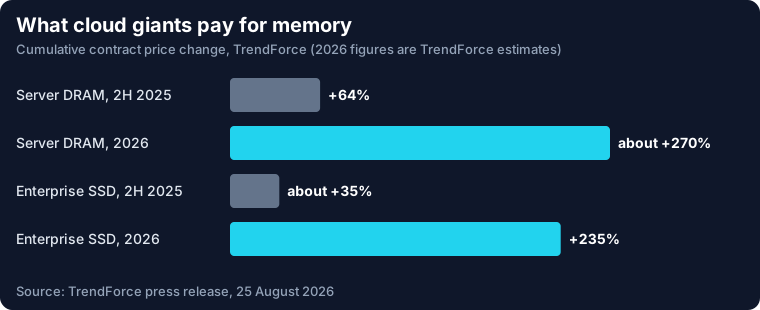
TrendForce estimates that server DRAM contract prices rose a cumulative 64% in the second half of 2025, with a further jump of approximately 270% expected in 2026. Enterprise SSD prices rose around 35% in the second half of 2025 and are projected to rise a cumulative 235% in 2026, it said in August.
Data
Server DRAM: +64% in 2H 2025, about +270% expected in 2026. Enterprise SSD: about +35% in 2H 2025, +235% projected in 2026.The latest forecast shows the pace slowing, not reversing. For the fourth quarter of 2026, TrendForce expects conventional DRAM contract prices to rise 10% to 15% on the previous quarter and NAND flash 15% to 20%. TrendForce says the pace is moderating, and for mobile DRAM it notes that large increases were already priced in during earlier quarters, but it still expects prices to rise across segments.
Server DRAM stays undersupplied. Enterprise SSDs are the only memory category where TrendForce expects a bigger increase than last quarter, because most new supply has already been committed and little is left on the open market.
Why the factories cannot just make more
The obvious question is why memory makers do not simply build more. They are. It is slow, and about 75% of Micron's 2027 output is already spoken for.
The first problem is that AI memory eats more of the same wafers. Samsung executive Kim Taewoo said HBM will take almost 30% of the industry's DRAM wafer capacity in 2027, up from 20% this year, Reuters reported, via The Next Web. Every wafer that becomes HBM is a wafer that does not become laptop or phone memory. Our explainer on DRAM, HBM and NAND walks through why.
The second is time. Micron plans new factory clean rooms in 2028, and Mehrotra said their output ramps up only gradually, so they will not quickly ease supply. TrendForce expects combined server DRAM and HBM bit supply to grow 27% in 2027, helped by new fabs in the second half of the year, and its initial estimate for total RDIMM server memory bit supply in 2027 is growth of only 15% to 20%, well behind server CPU shipments.
The third is that ordinary memory is being squeezed out. TrendForce says PC DRAM supply could decline in 2027 as more capacity shifts to servers, and that suppliers continue to scale back GDDR6 graphics memory while gradually exiting that market.
It is not only memory. TSMC, a major supplier to Nvidia and Apple, reported third quarter revenue of NT$1.494 trillion, up 50.9% on a year earlier according to its earnings release, and chairman and chief executive C.C. Wei said demand remains above its present supply capability, Let's Data Science reported.
Processor prices are moving too. Intel has raised prices three times since late last year, with some high-end Panther Lake chips up 15% to 20% from 1 September, and Qualcomm raised prices on Snapdragon X and X2 Elite PC platforms by approximately 10% from October, TrendForce reported, citing Commercial Times.
AMD is reportedly preparing adjustments for certain CPUs, though their size and timing are unconfirmed. Analysts expect TSMC to raise prices again in 2027, by 5% to 10% for advanced nodes and 10% to 15% for advanced packaging. More in Intel and Qualcomm just raised CPU prices.
The buyers with the deepest pockets
On the other side of the table are the cloud giants, and they have not slowed down.
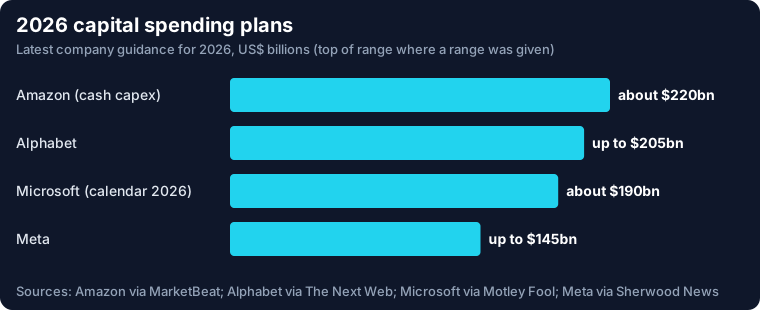
In April, Alphabet, Amazon, Microsoft and Meta planned to spend more than $700 billion on capital projects in 2026, nearly double what they spent the year before, Sherwood News reported. Since then, Alphabet and Amazon have raised theirs. Alphabet lifted its 2026 guidance to as much as $205 billion, from $180 billion to $190 billion, and said it would keep renting third-party capacity as a bridge because demand is outrunning what it can build, according to The Next Web.
Amazon now expects approximately $220 billion of cash capital spending in 2026, up from about $200 billion, with the increase driven by higher memory costs, MarketBeat reported. Chief executive Andy Jassy said demand would still exceed Amazon's capacity in 2026 and into 2027.
Data
Amazon about $220bn (cash capex). Alphabet up to $205bn. Microsoft about $190bn (calendar 2026). Meta $125bn to $145bn (April guidance).One detail stands out for buyers. Microsoft expects about $190 billion of capital spending in calendar 2026, and chief financial officer Amy Hood said about $25 billion of it simply reflects higher component prices, the Motley Fool reported. That $25 billion buys no extra capacity.
In our view, when one of the largest buyers in the world is paying that much more for the same parts, smaller buyers should not expect discounts.
TrendForce estimates that total capital spending by major cloud providers will rise 98% in 2026 and another 50% in 2027, and that DRAM and NAND's share of that spending will rise from 47% in 2026 to 68% in 2027. Its point is that higher memory prices and higher capex now feed each other.
Oracle reported remaining performance obligations of $664 billion in results filed on 10 September, up $209 billion on a year earlier, and said it booked more than $30 billion in new AI cloud contracts in a single quarter, according to a report on the results.
Google Cloud's backlog reached $514 billion, according to Alphabet's second quarter results. AWS's backlog stood at $496 billion and was growing at a triple-digit percentage rate, Jassy said on the earnings call. Dell booked $61 billion of AI server orders in one quarter and its AI backlog reached $95 billion, the Motley Fool reported, with chief operating officer Jeff Clarke saying the pipeline "remains multiples of our backlog."
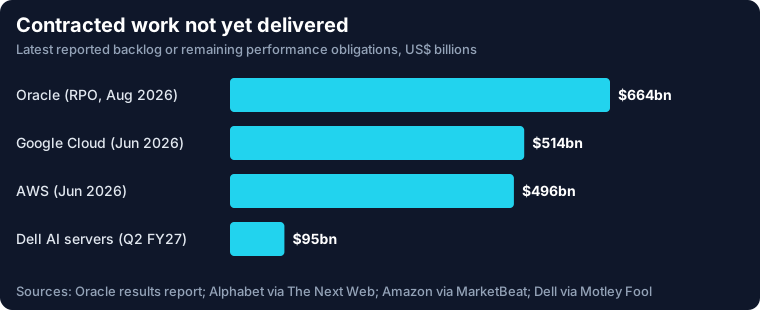
Data
Oracle remaining performance obligations $664bn. Google Cloud backlog $514bn. AWS backlog $496bn. Dell AI server backlog $95bn.Nvidia reported second quarter revenue of $96.2 billion, up 106% on a year earlier, with data centre revenue of $89.0 billion, and guided to $108.0 billion for the current quarter, according to its results. "The AI infrastructure buildout is at full steam," chief executive Jensen Huang said in the release.
Power is the slowest part of the chain
Even with the chips, a data centre needs electricity, and the grid moves on a timescale of years.
Google says utilities in many markets are telling it "four or five, sometimes ten years" to connect new data centres, and one told it 12 years just to study a connection request, Network World reported. Nearly 2,300 gigawatts of generation and storage capacity is waiting in connection queues.
Of 16 GW of data centre capacity announced for delivery in 2026, only about 5 GW was under construction as of this summer, according to TD Economics, via Power Engineering.
That stretches the build-out over more years, and much of the capacity planned for 2027 is already spoken for: Jassy said much of Amazon's capacity planned for 2027 is already reserved, with substantial customer commitments for 2028.
How it reaches everyone else
PCs and laptops. In December, Lenovo told customers that all current quotes would expire on 1 January 2026 and recommended ordering as soon as possible, while Dell was expected to raise prices by at least 15% to 20%, TrendForce reported.
Dell has since raised prices on products including PCs to protect its margins, The Standard reported. TrendForce also notes that PC brands are cutting SSD capacities in mainstream models to lower costs.
Apple. Apple has raised prices on Macs and iPads. "We have never seen a component price increase this much, this quickly," Apple said in a statement, Reuters reported. The MacBook Air with 512GB of storage went from $1,099 to $1,299 and the iPad Air with 128GB from $599 to $749. IDC expects the PC market to fall 11.3% this year.
Phones and small computers. Samsung has added $100 to most of its Galaxy S26 range, and Raspberry Pi has raised the price of its 2GB Pi 4 and Pi 5 by $12.50, citing memory costs. The 2GB Pi 4, once a $35 computer, now costs $67.50, The Next Web reported.
UK shops. Currys chief executive Alex Baldock warned on 2 July that higher prices for smartphones and laptops were coming, because AI and data centres are eating up the world's supply of silicon. "Less (is) left over for the likes of mobile phones and laptops," he said, Reuters reported.
In the first five weeks of 2026, analyst Context found the average UK distributor price of a consumer desktop had risen almost eight percent year on year to £565, The Register reported, and expected more inflation as older stock ran out.
Cloud and hosting. German provider Hetzner raised prices on many products by up to 50 percent, generally between 30 and 50 percent per service, from 1 April, for new orders and existing customers, citing the cost of hardware, DCD reported. "At OVHcloud, we estimate that the same server produced in December 2025 and December 2026 will cost between +15 percent and +35 percent more," founder Octave Klaba said.
People building their own AI machines. People who run large language models at home want lots of fast memory, which is exactly what is short. Apple pulled the 512GB memory option for the M3 Ultra Mac Studio in March 2026 and the 256GB option by May, leaving a single 96GB configuration, Let's Data Science reported, with consumer local LLM tools cited as one reason for the run on high-memory configurations.
Graphics card prices are rising too. Asus and Gigabyte raised prices across their RTX 50 and Radeon RX 9000 ranges for the second time this year, with the RTX 5080 rising by between $207 and $222. If you are weighing up a home AI build, our guide on whether to buy RAM now or wait covers the timing.
J.P. Morgan estimates that DRAM prices will have risen more than 400% from the start of 2024 to the end of 2026, and J.P. Morgan economist Abiel Reinhart noted that the US producer price index for storage devices and the consumer price index for software and accessories have both risen 23% since the end of 2024, it said in August.
"It is not a secret that the industry will stay in shortage for multiple years," said Jay Kwon, a J.P. Morgan analyst covering memory.
Why this is not the dot-com bubble
When spending grows this fast, the comparison with 2000 is inevitable. There are real differences, and they matter for how long the shortage lasts.
The money is real revenue, not just promises. The suppliers are booking real revenue now: Micron generated $89.68 billion of operating cash flow in fiscal 2026, and Nvidia's quarterly revenue has more than doubled in a year. The buyers report contracted backlogs in the hundreds of billions of dollars, as the backlog chart above shows.
The builders mostly pay from their own cash. LPL Financial chief equity strategist Jeff Buchbinder says the leaders of the AI build-out are financing their growth with internal cash flow rather than "speculative capital raising," The Wealth Advisor reported.
Valuations are lower. Buchbinder puts the tech sector at roughly 25x forward earnings, against 58x in March 2000. The Nasdaq 100 has gained more than 140% since the launch of ChatGPT, against a 1,090% return at the dot-com peak in March 2000. He argues the market "may be more like 1997 than late 1999 or early 2000."
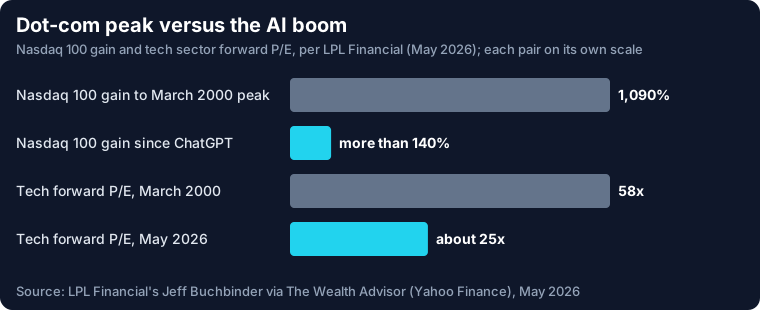
Data
Nasdaq 100 gain: 1,090% to the March 2000 peak, more than 140% since the launch of ChatGPT. Tech sector forward P/E: 58x in March 2000, roughly 25x in May 2026.The contracts lock buyers in. Samsung's deals run for at least five years with upfront payments and floor prices. TrendForce says several US cloud providers have signed multi-year agreements that restrict suppliers from raising prices for them.
The limits are physical. Wafers, clean rooms, packaging lines and grid connections take years to add, and Micron says about 75% of its 2027 output is already spoken for.
What could go wrong
None of that makes the boom risk-free, and it would be dishonest to pretend otherwise.
Free cash flow has turned negative at some of the biggest builders. Alphabet's free cash flow was negative $5.9 billion in the second quarter, its first quarterly outflow in nearly two decades, and it has leaned on a record $85 billion equity raise, The Next Web reported.
Oracle's free cash flow was negative $5.4 billion, its interest expense rose 55% to $1.4 billion on higher debt and it completed a $20 billion equity issuance, according to a report on its results. Some strategists note that hyperscaler debt issuance has ballooned to fund the spending.
Circular deals. Nvidia is guaranteeing up to $105 billion for OpenAI's planned data centre campus in Ohio, down from the roughly $250 billion it was considering, Fortune reported. Fortune noted growing questions about a financing model in which the dominant AI chipmaker helps finance the infrastructure that creates demand for its own chips. When reports of the larger figure surfaced in July, Nvidia's shares fell about 4.5% intraday.
New supply is coming. In July, SK hynix guided to lift 2026 capital spending by 50% to at least $31 billion, and a strong Shanghai debut by Chinese memory maker CXMT revived fears of oversupply, according to a market report.
Demand can bend. TrendForce notes that NAND wafer prices have reached levels downstream retail channels are increasingly unable to absorb, and in a separate report says cloud providers could cut memory per system to manage costs. High prices can shrink demand at the edges.
What the markets are saying
The markets have been swinging rather than marching up in a straight line. The Philadelphia Semiconductor Index fell 19% in July, on track for its worst month since 2008, 24/7 Wall St reported. Oracle closed at $150.15 on 11 September, 50.63% below its level a year earlier, while its backlog was up $209 billion on a year earlier.
On the other side, TSMC's Taipei-listed shares had risen 64.52% this year by 8 October, KSL reported, and Dell's shares had more than tripled this year by the time of its latest results, The Standard reported. These are past price moves, not predictions, and nothing here is investment advice.
What this means for you
Large enterprises. Expect higher prices on servers, storage and memory-heavy refreshes, and longer waits for specific configurations. TrendForce says increases for some buyers lag the market because of long-term agreement pricing, and that from the third quarter of 2026 the main source of server DRAM price rises shifts to customers without such agreements.
If you do not have one, you are in the group paying the market rate. Cloud capacity is not unlimited either: Amazon says demand will exceed its capacity in 2026 and into 2027, and Alphabet is renting third-party capacity while its own data centres come online.
Small and medium businesses. You feel it through laptops, desktops, NAS and backup storage, and hosting bills. Quotes are shorter lived, as Lenovo's notice showed, and some suppliers reprice existing customers too, as Hetzner did from 1 April. Plan your next PC refresh and storage expansion now rather than at the end of the financial year.
If backup capacity is part of the plan, our free backup storage calculator shows how much you actually need before you ask for quotes.
Everyday users. Many laptops, phones, graphics cards and even hobby computers cost more than they did a year ago, and PC makers are fitting smaller SSDs to mainstream models to hold prices down. If your current device works, keeping it longer is a sensible option. If you need to replace it, buying sooner is likely to cost less than buying later.
If you are buying or renewing: move now
If you are in a renewal or buying phase, waiting is unlikely to help. Micron says the market will be tighter in 2027 and 2028 than in 2026, TrendForce expects contract prices to keep rising in the fourth quarter, and price rises have already been announced or reported for Apple, Dell, Intel, Qualcomm, Samsung's Galaxy S26 range, Raspberry Pi and Hetzner. This is guidance, not a guarantee, but every published forecast in this piece points the same way.
- Get quotes in writing and check how long they are valid. In December 2025, Lenovo told customers that all its current quotes would expire on 1 January 2026. Ask for the validity date and the price protection terms before you start internal approval.
- Commit early. A quote you have not signed protects nothing. If the budget is approved, place the order and take delivery where you can.
- Buy memory and SSD heavy kit first. Servers, storage arrays, NAS boxes, high-memory laptops and workstations carry the largest exposure, because memory is the component rising fastest.
- Lock longer terms on contracts. Where the purchase is a contract or subscription, such as hardware support and maintenance renewals, hardware as a service, cloud reserved capacity or savings plans, managed service agreements, or software tied to hardware, consider a longer term of three to five years to fix today's pricing. The memory makers are doing exactly this with their biggest customers. Before you sign, check for a price hold or price protection clause, a cap on annual uplifts and clear exit terms. The trade-off is less flexibility and a commitment you have to keep if your needs change.
- Renew before stated deadlines. When a provider announces a price change with a date, as Hetzner did, renewing before that date can hold the old rate.
- Check lead times before you plan a project. Some configurations have been pulled from sale: Apple dropped the 512GB and 256GB memory options for the Mac Studio, leaving a single 96GB configuration. Build a fallback model into your plans.
- For home buyers. If you need a PC, phone or graphics card in the next year, buying when you see a fair price is likely to beat waiting, on current forecasts. Treat any dip as a sale, not a trend.
Our view
This is analysis, not a forecast of our own. In our reading, the evidence points to a shortage rooted in physical limits and signed contracts, not in a burst of speculative enthusiasm. The companies building AI infrastructure are still raising their spending plans, Micron says about 75% of its 2027 output is already spoken for and that most sales talks are about 2028, and new factories and power connections take years. That is why TrendForce expects prices to keep rising even as the pace slows.
It could still end badly for some of the companies involved. But for people buying hardware, the practical question is whether prices will be lower when you next need to buy. On the forecasts published so far, we think the answer for the next year is probably not.
Sources
- TrendForce: 4Q26 memory contract price forecast
- Micron fiscal Q4 2026 earnings release (SEC)
- The Next Web: Micron sees the shortage tightening into 2028
- TrendForce: memory to reach 68% of CSP capex in 2027
- TrendForce: long-term agreements and 3Q26 server DRAM prices
- TechSpot: Samsung locks in five-year chip deals
- Reuters via KSL: TSMC record Q3 revenue and Samsung profit guidance
- Let's Data Science: TSMC says AI demand exceeds supply
- Nvidia Q2 fiscal 2027 results (SEC)
- Sherwood News: Big Tech plans more than $700bn of capex
- Motley Fool: Microsoft plans $190bn of capital spending
- MarketBeat: Amazon Q2 2026 earnings call
- The Next Web: Alphabet lifts capex guide to $205bn
- 24/7 Wall St: Oracle $664bn backlog
- Motley Fool: Dell AI server orders reach $61bn
- Reuters via The Standard: Dell raises forecasts and prices
- Reuters via Khaleej Times: Apple raises Mac and iPad prices
- TrendForce: Dell and Lenovo price rises and quote expiry
- TrendForce: CPU price hike wave
- The Register: UK PC prices rising
- Reuters via The Star: Currys warns of price rises
- DCD: Hetzner raises prices by up to 50%
- Network World: Google on grid connection delays
- Power Engineering: data centre grid delays
- The Wealth Advisor: AI boom versus the dot-com era
- Fortune: Nvidia and OpenAI data centre guarantee
- 24/7 Wall St: July memory selloff
- J.P. Morgan Global Research: the DRAM shortage
- Let's Data Science: Mac Studio memory options cut
- The Next Web: Asus and Gigabyte raise GPU prices again